Why Self-Care Needs to be Non-Negotiable in a Busy Life to avoid burnout
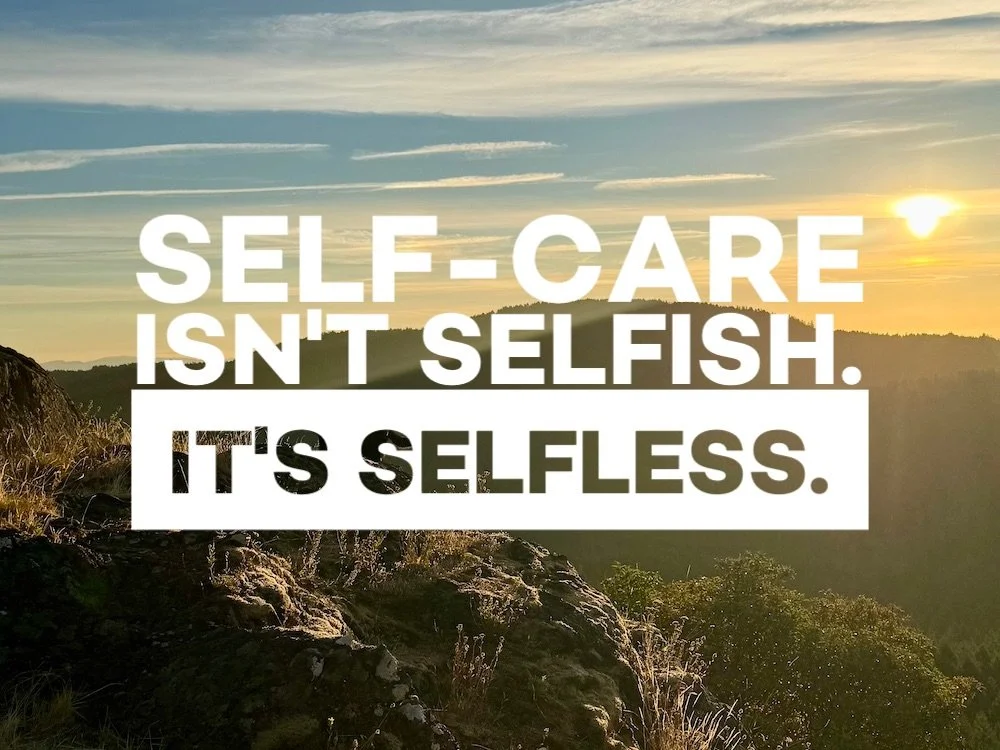
Let’s be honest: most of us treat self-care like a luxury, not a necessity.
I get it because I’ve lived it. When life feels like one big to-do list, finding even ten minutes can feel impossible.
And when you finally do? You feel guilty because it means you’re selfishly taking time away from the people who count on you: your kids, your partner, your clients, or your team.
We weren’t built to run on empty, but most of us try anyway.
Unfortunately, most of us were raised to put ourselves last, and then we wonder why we end up running on fumes. But it doesn’t have to be so hard, and you don’t need to feel guilty.
Here’s the truth: Self-care isn’t selfish; it’s selfless because the people you love and the people you lead deserve the best version of you.
They need you to take care of yourself as much as you need you to take care of yourself.
What happens if you don’t?
It’s called Burnout.
If you spend enough time feeling overwhelmed, where substantial stress is the norm, it’s a slippery slope toward burnout.
If you stay in burnout long enough, it’s a steeper slope toward low mood, low motivation and, in some cases, depression.
Your central nervous system can’t take that kind of burden for weeks or months on end. Eventually, something gives. When your nervous system stays in go-mode too long, your body eventually pulls the emergency brake for you, usually through fatigue, irritability, or shutting down.
If you don’t want to break, you must take care of yourself. It must become a non-negotiable part of your week that, by design, you don’t waiver on.
The most Common Objection: But Mike, “I just don’t have time…”
I hear you, life is busy, but there’s always time to make yourself a priority. You might not have an hour per day, but you’ve almost always got an extra hour or two per week.
It doesn’t have to be long, but it does need to be prioritized. For many people, if it isn’t on their calendar, it may never happen. So, you need to learn to treat your self-care time the same way you’d treat a meeting you can’t miss.
You don’t need a wellness retreat. You need small, consistent choices that refill your tank.
What is Self-Care, and How do you Incorporate it in a Busy Life?
Self-care isn’t a single practice; it’s an interconnected puzzle with the pieces working together to enhance your well-being.
I don’t know if there’s a widely accepted definition of self-care, but I define it as anything you do that helps you recharge, feel good about yourself, and replenish your energy.
Self-care looks different for different people. For me, hiking or running is my moving meditation (my dog also loves these). Lifting weights gives me the hits of dopamine I crave. Skiing is my ultimate self-care “fix,” but it’s not always accessible. Sometimes it’s a dose of education while reading with my morning coffee. It’s also my recreational reader as a way to wind down at bedtime. Self-care might also include recognizing that sometimes I need sleep and a healthy dose of self-compassion if I miss my morning workout.
Pro Tip #1: Self-Compassion is self-care. Don’t get so caught up in your self-care routine that you feel guilty if you miss a day. A ”no days off” mentality does not apply here.
For you, it could be a walk in the woods, yoga, meditation, light exercise, a cold plunge, soaking in the tub, waking up to some sunshine, a healthy diet, good hygiene, sports (even extreme sports), rational use of health products, or avoiding substance use and alcohol.
Self-care comes in many forms, whether it’s mental well-being, physical activity, healthy eating, health literacy, good hygiene, risk avoidance, sleep, or the responsible use of products and services. How you engage is up to you, but the most important thing is making it a priority.
Pro Tip #2: Self-coping is not self-care. Using substances to avoid stress can actually make stress and burnout worse in the long run. A few drinks or short-term escapes might feel helpful in the moment, but they quietly drain your resilience the next day.
Another Non-Negotiable: Boundary Setting
Setting personal boundaries is another vital form of self-care that could require its own entire blog post. (If you like it, let me know, and I’ll write about it next month!)
Setting healthy boundaries is an invaluable form of self-care because your boundaries protect your energy, esteem, confidence, and self-worth. It’s okay to say no, and your “no’s” make your “yes’s” more powerful.
Let’s start with a new firm boundary, a line you do not cross, where you don’t sacrifice self-care. Make It Non-Negotiable.
Designing Your Week Around Self-Care
First, take a look at your calendar. You always have 1-2 hours a week to set aside for something fun, refreshing, or rejuvenating. Ideally, this would be the first thing that goes on your calendar, but choose a time that works and lock it in. Treat it like a meeting with yourself that you just can’t miss.
Pro Tip #3 (for those of you in relationships): If you want guilt-free time for your self-care, only take your reserved time slot after your partner takes theirs. Get them on board, and let them know their self-care matters to you, too. Prioritizing self-care becomes a lot easier when you’re not trying to do it alone. Self-care can also be a team effort. Date nights are an extremely healthy “non-negotiable.” Schedule them and follow through.
When it Comes to Self-Care, Remember:
Self-care feeds your energy, and it feels good to feel good.
It’s okay to put yourself first, so make yourself your priority.
Make it non-negotiable because you are worth it, and the important people in your life deserve the best version of you.
Keep the promises you make to yourself. After all, if you can’t show up for yourself, how can you keep showing up for others?
We all show up better when we feel grounded, rested, fulfilled, and connected to ourselves. The people in your life benefit most when you feel strong, steady, and restored—not when you’re stretched so thin you’re barely holding on.
I hope this helps.
With gratitude,
Mike Shaw
Looking for More Mental Health Tips?
Subscribe to the Gratus Health newsletter for practical tools to improve clarity and focus, reduce stress, become more resilient, and boost your mental wellbeing—one small shift at a time.
PS. I am more excited than ever about helping people through GratusHealth.com, and I am still accepting new clients. Do you know someone who needs support?
Please share this post or let them know I’m here to help.
Connect directly at mike.s@gratushealth.com.
Thanks for being part of my community!
Resources:
Pillars of Self-Care: https://www.canada.ca/en/department-national-defence/maple-leaf/defence/2024/07/self-care-what-it-really-means.html
Understanding the Burnout Experience: https://pmc.ncbi.nlm.nih.gov/articles/PMC4911781/