How much of your mental health is perspective?
SOMEONE RECENTLY ASKED ME, “HOW IMPORTANT IS PERSPECTIVE FOR YOUR OVERALL MENTAL HEALTH?”
In other words, how much does your mindset influence your mental health?
This got me thinking…
A few years ago, I might have said it was almost 100% perspective. Which makes sense because at the time I was working primarily with athletes, teams, and corporate groups to shift their… You guessed it… mindset.
But that only focuses on perspective and underestimates the role of your emotional state, behaviour, and physiology in our mental health and performance.
Perspective lands in the cognitive domain, but our thoughts don’t operate alone.
Now, I’d estimate that the quality of our mental health relies on perspective closer to 25-40% (as a guide rather than a rule). The rest is balanced across behaviour, emotions and physiology, and our environment.
Perspective does carry a lot of weight because the way we interpret events influences our emotional intensity and behaviour. Research on emotional regulation finds that cognitive reappraisal, or changing how we view a situation, significantly affects our emotional experience by improving regulation (Gross, 2015)
At the same time, broader research supports Cognitive Behavioural Therapy (CBT) as an effective approach for improving mental health across a range of emotional states and conditions (Hoffman et al., 2012).
Basically, what we think about matters, but it does not operate independently of the state our nervous system is in. How we feel and how we behave also shape our thoughts!
The Cognitive Triangle
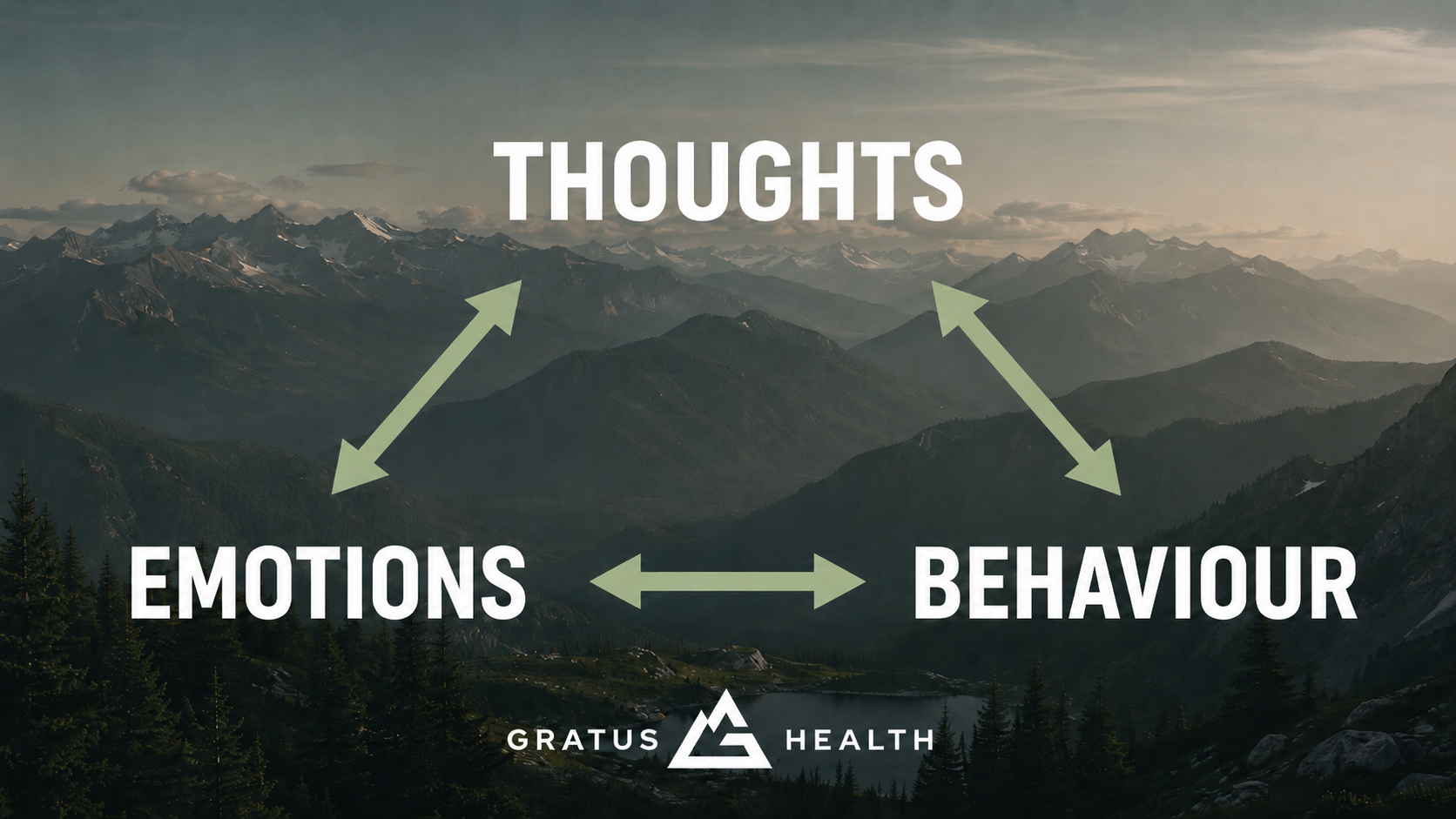
Within CBT theory, there are three domains: cognitive, emotional, and behavioural. You can think of them as the three legs of the same stool. They all rely on each other to keep the stool upright.
The cognitive triangle shows us that thoughts, feelings, and actions are interconnected levers that influence mental health. When you shift one area, it creates movement in others.
This means that well-being can be improved in the emotional and behavioural domains, not just by “thinking differently” or choosing a different perspective.
Perspective matters, but lasting change requires behavioural interventions or emotional processing alongside cognitive work.
A simple way to understand this concept involves physical exercise. After a hard workout, run, or walk outside, you almost always feel better emotionally and physically. The positive shift in mood, energy, and nervous system activation generally leads to more positive thinking, increased self-esteem, and greater self-confidence.
However, the reverse can also happen.
When you don’t feel like moving and decide not to, it usually reinforces the very states you’re trying to avoid, like low motivation, negative self-talk, or a sense of being stuck. So, your behaviour is not just a result of how you feel; taking action can also influence how we feel or think.
Likewise, processing emotions like anxiety, fear, sadness, guilt, shame, or low mood can affect how you behave or think. Emotional processing helps you tackle cognitive and behavioural patterns that arise from these emotions, such as avoidance, withdrawal, or procrastination.
Similarly, addressing how you feel about and view environmental factors such as a toxic workplace, a challenging relationship, or a lack of support is also effective in promoting healthy behaviours and thinking.
It’s not just perspective.
When you conceptualize your mental health in terms of these three domains, it gives you a stronger sense of agency and control over your mental well-being.
Then it becomes a matter of learning the tools in each domain to respond intentionally, make changes, and take definitive action toward resolving pain and optimizing your mental health.
I think a better question than “Is my mindset the problem?” is: “Which domain needs attention right now?”
I hope this helps. Let me know if it resonates!
With gratitude,
Mike Shaw
Do you know someone who needs support?
Please share this post.
Connect directly at mike.s@gratushealth.com.
And please grab a copy of Never Part of The Plan if you haven’t already!
Thanks for being part of my community. I’m thankful for the meaningful changes I’m helping people make with GratusHealth.com.
Resources:
Gross, J. J. (2015). Emotion Regulation: Current Status and Future Prospects. Psychological Inquiry, 26(1), 1–26. https://doi.org/10.1080/1047840X.2014.940781
Stefan G. Hofmann et al. (2012). The efficacy of cognitive behavioral therapy: A review of meta-analyses. Cognitive Therapy and Research, 36(5), 427–440. https://doi.org/10.1007/s10608-012-9476-1